
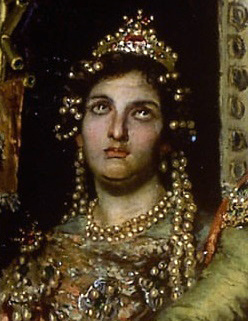
As we have already mentioned in another publication, Queen Baddo was the first and only Visigoth queen to sign in a council, specifically in Council III of Toledo (589).
But what motivated this signature in the council minutes? This was not a simple signature. We are looking at the first Germanic queen to sign the minutes of a council.
The traditional thesis holds that his signature is the product of an imitation by King Reccared (586-601) of the Eastern Roman Emperor Marcian (450-457), who appears with his wife, Pulcheria, at the celebration of the Council of Chalcedon (425).
A council with a special significance for Reccared’s project to establish Catholicism in the Visigothic kingdom, since it condemned the Monophysites. A branch of Christianity that considered the existence of a single nature in Christ, denying the dual human and divine nature of the same, with the divine nature prevailing exclusively.
The model of the Council of Chalcedon was copied at the Third Council of Toledo. But there is a difference in the treatment of the two women at the aforementioned councils.
Whereas at the first council acclaim was given to Pulcheria, who was considered a new ‘Helen’, mother of Emperor Constantine I (306-337). Whereas at the Toledan council there was no ovation for Queen Baddo.
But even though there was no ovation of this kind for Baddo, it is possible that Recaredo’s desire to assimilate himself to Constantine influenced the Visigoth queen’s signature. Thus presenting his wife as a defender of Orthodoxy, just as Helena was.
And you? Did you know the story behind Queen Baddo’s signature? Follow us to learn more about the wonderful world of the Visigoths, historiography and, of course, AI.
Alfonso García Sánchez
